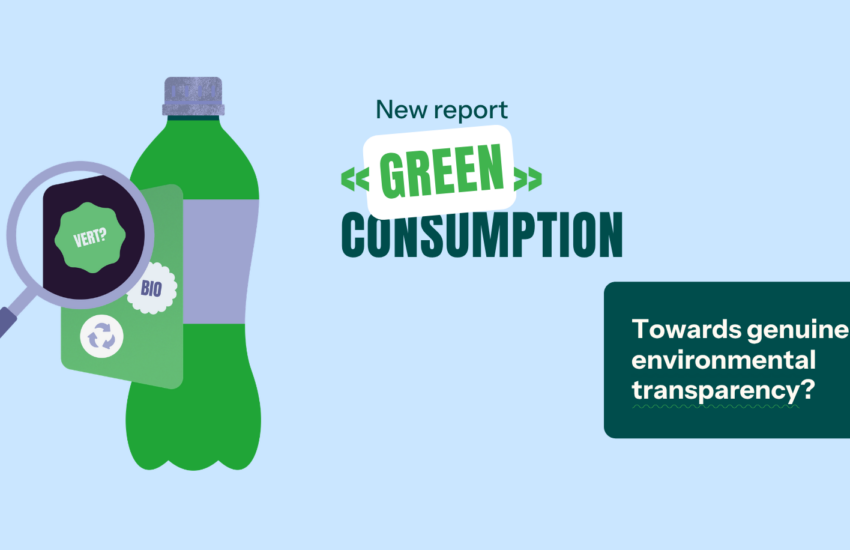
Montréal, March 26, 2026 – The Centre québécois du droit de l’environnement (Québec Environmental Law Centre, or CQDE) is releasing a new research report today titled “Green” Consumption: Towards Genuine Environmental Transparency?. This report demonstrates that, despite the proliferation of environmental claims regarding consumer products, consumers still do not have access to reliable and comprehensive information to inform their choices towards greater eco-responsibility.
A lack of information that undermines “green” choices
Whether buying a car, food, or electronics, consumer decisions have significant environmental impacts. Yet the vast majority of advertisements, packaging, and marketing communications provide no information on products’ actual environmental footprint.
When information is provided by companies, it is often incomplete, difficult to understand, verify, or compare, leading to confusion rather than informed choices. According to a Deloitte survey from 2023 :
- 23% of Canadian consumers said they were frustrated by the difficulty of distinguishing true environmental claims from false ones.
- 49% of Canadian consumers refuse to pay a higher price for “sustainable” products because they find it difficult to understand certain claims and 46% doubt the veracity of companies’ environmental claims.
“Citizens want to make choices consistent with their environmental values. But the information made available to them must be clear and reliable. Currently, the burden too often falls on the shoulders of the public,” emphasizes Geneviève Paul, Executive Director of the CQDE.
Five recommendations to restore transparency
To address the identified gaps, the CQDE has formulated five key recommendations:
- Establish an environmental labeling system.
- Strengthen the regulatory framework for environmental certifications.
- Make the disclosure of evidence supporting environmental claims mandatory.
- Strengthen enforcement of legislation that regulates misleading advertising.
- Prohibit certain advertising representations that are inherently misleading.
According to the CQDE, these measures are essential to protect the public, ensure fair competition, and support a genuine ecological transition.
“The green transition cannot be based on vague or misleading marketing promises. It requires a robust legal framework capable of ensuring real transparency and preventing greenwashing from undermining public trust,” adds Geneviève Paul.
The CQDE notes that these measures alone will not be sufficient to ensure the ecological transition. Beyond consumer protection, however, they serve as a key lever to curb greenwashing practices that hinder the achievement of climate and biodiversity protection goals, particularly by enabling the public to participate more effectively in the transition.
-30-
Additional Information
The CQDE has received funding from Innovation, Science and Economic Development Canada’s Canadian Consumer Protection Initiative. The views expressed in this report are not necessarily those of Innovation, Science and Economic Development Canada or of the Government of Canada.
Also contributed : Law for the Future Fund of the Canadian Bar Association and the Ministère de l’Environnement, de la Lutte contre les changements climatiques, de la Faune et des Parcs.